Listen. Most people think the biggest cost of a fishing trip is the gas, the bait, or the $12 sandwich you bought at the marina.
They’re wrong.
The biggest cost is the “Incompetence Tax”. It’s the money you lose because you didn’t have a system to prevent a predictable mistake. In business, that’s a bad hire. In fishing in the dark, it’s a snapped rod tip.
I’ve seen it a hundred times. A guy buys a $300 high-modulus carbon fiber rod. He pairs it with a smooth-as-butter reel. He’s got the “perfect” setup. Then the sun goes down.
He’s out there fishing in the dark, high on the “thrill of the catch”. He makes a long cast, starts his retrieve, and—SNAP.
He reeled the lure right into the top eyelet because he couldn’t see where his line ended.
That is a $300 tax for not having a 50-cent solution. If you want to scale your success on the water, you have to stop the snap. You need a fishing rod tip light.
1. Why Your Eyes are Lying to You
Here is the “Value Proposition” of your eyes: they are great at 12:00 PM and terrible at 12:00 AM.
When you’re fishing in the dark, your depth perception goes to zero. You think your lure is 10 feet away. It’s actually 2 feet away.
Most night fishing tips tell you to use a headlamp. Here’s why that’s a “low-leverage” move:
- Night Vision Sabotage: Every time you click that headlamp on to check your rod, your pupils constrict. You just reset your night vision clock. Now you’re blind for the next 10 minutes.
- The Spook Factor: Light on the water scares fish. If you’re swinging a bright beam across the surface, you’re basically screaming “DANGER” to every trout or bass in the area.
- Friction: It’s an extra step. You have to reach up, click, look, click, and then get back to your retrieve.
If you want to be efficient, you need a “Passive Information System”. You need a fishing rod tip light that stays on, stays low-profile, and tells you exactly where your rod ends without you having to do a single thing.
2. The “Aerodynamic” Advantage
A lot of guys say, “Alex, I don’t want to clip something to my rod. It’ll ruin my cast.”
This is “Short-Term Thinking”.
At LYT N BUGG, we didn’t just tape a bulb to a stick. We engineered a fishing rod light to be aerodynamic. It’s designed to attach securely to any rod tip without affecting your casting distance or accuracy.
Think of it like an “Upgrade” to your hardware.
- It doesn’t dampen the sensitivity.
- It doesn’t create wind resistance.
- It just adds Value.
If you can cast 50 yards during the day, you can cast 50 yards at night—only now, you actually know when to stop reeling.
3. Scaling Your Productivity (The Multi-Rod Spread)
In my business, I don’t just run one ad. I run a “spread”.
If you’re a serious angler, you aren’t just holding one rod. You’ve got a “spread” out on the water.
Maybe you’re trolling with planer board lights.
- The planer board lights define your footprint. They tell other boaters where your gear ends.
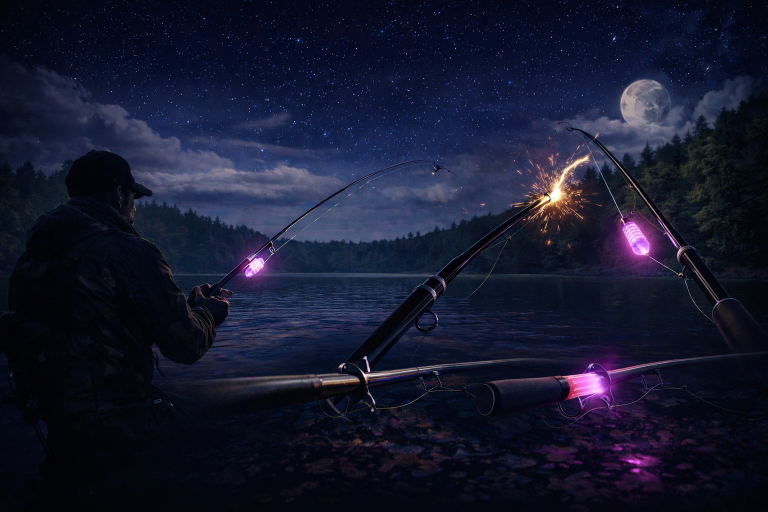
- But the fishing rod tip light tells you when you have a hit.
If you’re sitting in the dark with four rods in holders, you are playing a “Guessing Game”. You’re waiting for the sound of a clicker.
But if every rod has a fishing strike indicator light, you can see the stutter before you hear the scream. You react faster. Your “Conversion Rate” (hook-ups to landings) goes up.
4. The “DIY” Debt
I love a good hack. But “Cheap” is usually the most expensive way to go.
The night fishing tips from 1995 suggest taping a chemical glow stick to your rod.
Here’s why that’s a “Bad Investment”:
- Reliability: They leak. They go dim. They die after four hours.
- Waste: You throw them away every night.
- The Glue Factor: Tape leaves a sticky residue on your $300 rod.
A battery powered rod tip light is a “Capital Expenditure”. You buy it once. It works every time. It’s water-resistant. It’s rugged. It’s a professional tool for a professional result.
5. The “Visual Strike” Zone
Let’s talk about the “Close”.
In sales, the “Close” is where the money is made. In fishing, the “Close” is the strike.
When you’re fishing in the dark, most strikes are “felt,” not seen. But what about the “Soft Hits”? The trout that just nudges the lure? The crappie that “lifts” the bait?
If your rod is dark, you miss those “Market Signals”.
But with a luminous fishing rod tip, you see the movement. You see the tip dip half an inch. You see the “slack line” hit.
You aren’t just fishing; you’re monitoring the data in real-time.
6. Safety is High ROI
Listen, I’m an outdoorsman. I’ve been out on the water when the landmarks disappear and the shoreline blurs.
If you are “Invisible,” you are a target.
Using fishing accessories night enthusiasts trust—like our LED light for fishing rod systems—isn’t just about catching fish. It’s about not getting run over.
When you use a “Layered Lighting” approach—planer board lights to mark your perimeter and rod tip lights to mark your “strike zone”—you are creating a visual footprint that keeps you safe.
It tells every other vessel exactly where your gear ends and where the safe water begins.
7. The “Veteran-Owned” Standard
At LYT N BUGG, we are veterans.
- Ken: Vietnam Army.
- Tracy: Cold War Navy Submarine Force.
In the military, gear cannot fail. If it fails, people get hurt.
We brought that same “Zero-Failure” mindset to our night fishing gear.
- Our lights are bright.
- They are dependable.
- They are built to last through the toughest conditions.
We didn’t build these to be “trinkets”. We built them to be practical, durable lighting solutions that enhance every nighttime angling experience.
The Bottom Line
You have two choices.
- Keep fishing in the dark the old way. Squint at your rod, use a bulky headlamp, and hope you don’t snap a $300 tip when a big one hits.
- Invest in a system. Get the LYT N BUGG LED Rod Tip Light.
Stop paying the “Incompetence Tax”. Stop the snap.
Boost your visibility. Attract more fish. And most importantly, stay on the water longer.
